
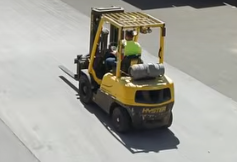
Forklifts on site are a critical risk. If forklifts are part of your business — even occasionally — their operation will inevitably be one of your critical risks.
Forklifts combine heavy mobile equipment, restricted visibility, pedestrians and moving loads. When something goes wrong, it tends to happen quickly and with serious consequences.
And forklift events happen all the time – ACC recorded 1,041 claims for forklift-related injuries in 2025.
What are the risks in using forklifts?
The major risks include:
- Pedestrian strike – a person is hit, trapped or crushed by a moving forklift.
- Forklift rollover or tip-over – potentially crushing or seriously injuring the operator or people in the vicinity.
- Falling loads – loads falling from the forks onto workers, equipment or facilities.
- Collision and crushing – the forklift, forks or load striking people, racking, equipment, doors or other structures.
These risks exist because:
- Forklifts and people often work in the same areas, sometimes without effective pedestrian segregation.
- Forklifts frequently operate in restricted spaces and with limited visibility.
- Forklifts are used for many different tasks, sometimes with unsuitable attachments or incorrectly positioned loads.
- Forklift safety ultimately depends heavily on the decisions and behaviour of the operator.
There are three areas we particularly focus on: pedestrian segregation, operator competence and equipment.
Managing forklift related risk
1. Pedestrian segregation
The most effective way of preventing a forklift from hitting a pedestrian is to keep the two apart.
A good traffic management system should consider:
- defined vehicle and pedestrian routes;
- physical barriers wherever reasonably practicable;
- clearly marked pedestrian walkways;
- designated crossing points;
- controlled pedestrian gates and warning beacons where appropriate;
- mirrors and other controls at blind corners;
- forklift exclusion zones;
- speed limits; and
- clearly defined right-of-way rules.
High-visibility clothing, warning systems and clear rules complement segregation—they don’t replace it.
The rules also need to be included in operator training and site inductions, modelled by management and consistently enforced.
Our experience with pedestrian segregation
CHEP identified pedestrian segregation as a significant risk across its seven New Zealand manufacturing sites.
Winsland provided the Health & Safety expertise for CHEP’s pedestrian-segregation project. The project delivered a significant improvement in workplace safety and gave us considerable practical experience in assessing forklift/pedestrian interaction and developing workable controls.
If forklift and pedestrian interaction is a concern in your workplace, Winsland can assess the risk and recommend practical improvements – don’t leave it to the Engineers alone.
2. Operator training and competence
Having a forklift certificate is not, by itself, evidence that somebody is competent to operate a forklift safely in your workplace.
Under the Health and Safety at Work Act 2015, a PCBU must, so far as is reasonably practicable, provide the information, training, instruction and supervision necessary to protect people from risks arising from the work.
In practice, forklift competence has two important components.
Forklift operator training
WorkSafe continues to publish the Approved Code of Practice for Training Operators and Instructors of Powered Industrial Lift Trucks (Forklifts).
The ACOP was issued in 1995 and predates the current Health and Safety at Work Act. However, it remains useful guidance on the standard of forklift training expected in New Zealand.
The normal training process results in a Forklift Operator’s Certificate, which the ACOP provides should be renewed every three years.
But that is only part of the process.
Site-specific training and authorisation
An operator also needs to demonstrate that they can operate the actual forklift safely in the environment in which they will work. And this is the part that is often missing.
Competence should then be verified through a practical, on-the-job assessment by a competent person. The ACOP includes an example assessment in Appendix D and provides for the employer to issue an Authorisation to Operate once the operator has satisfactorily completed the required training and assessment.
This distinction is important:
Operator Certificate + Site-Specific Training + Practical Assessment = Authorised and Competent Operator
Winsland can help businesses establish a simple system for site-specific forklift training, competency assessment and authorisation.
What about an F endorsement?
An F endorsement is different.
It is required when a forklift is driven on a legally defined road. The definition of a road is broader than simply a public street and can include some areas to which the public has access.
For forklifts used entirely within a workplace that is not a road, the F endorsement is generally not the relevant requirement. The important issue is ensuring the operator is properly trained, assessed and competent for the work they perform.
3. Equipment options for reducing forklift risk
Operator competence is only one part of forklift safety. The forklift itself must be suitable for the work, properly maintained and equipped with the appropriate safety features.
Depending on the forklift and its operating environment, important controls can include:
- Operator restraint/seatbelt – keeps the operator within the protective zone of the forklift during a rollover.
- Overhead guard – protects the operator from falling objects, within its design limitations.
- Horn – allows the operator to warn pedestrians and other vehicle operators.
- Reversing or movement warning systems – where appropriate to the operating environment.
- Warning lights or beacons – to improve awareness of moving forklifts.
- Proximity warning systems – increasingly useful where forklifts and pedestrians cannot be completely separated.
- Suitable attachments – designed, rated and approved for the forklift and the task.
- Load-rating information – clearly displayed and applicable to the forklift/attachment configuration.
These controls do not substitute for good traffic management, competent operators and effective pedestrian segregation.
Ask yourself – is our forklift use as safe as it could be?
The key questions each business needs to ask – including those who use Forklifts only occasionally – are;
- Are pedestrians effectively separated from forklifts?
- Has the operator been trained and assessed for this forklift, this task and this workplace?
- Are we doing all it is reasonably practicable to do to ensure our forklifts are equipped be as safe as it is reasonably practicable to make them?
If the answers are “yes” then well done. If there is room for improvement, maybe it is time to take some expert advice.