
Are we compliant?
How do I know we are compliant?
These are common questions from small to medium businesses in Auckland and throughout NZ, on the matter of H&S compliance.
Whilst one off questions are easy to address, to answer this question on the business as a whole requires the conduct Health and safety audit and inspections to ensure H&S compliance for a SME.
Where compliance requirements come from
There are a multitude of sources of health and safety compliance requirements.
HSWA
The Health and Safety at Work Act 2015 (HSWA) is the most wide-reaching piece of health and safety legislation in New Zealand. The Act is not highly prescriptive; rather, it relies on several key concepts that have broad application and scope.
Principally, this is the concept of duty holder responsibilities. This means that a business and its officers, as a PCBU (Person Conducting a Business or Undertaking), have the primary duty of care. In practical terms, this means managing risks to ensure that no harm arises from the conduct of the business.
Compliance therefore requires businesses to understand their risks and, so far as is reasonably practicable, eliminate or minimise those risks.
General Risk and Workplace Management Regulations
The Health and Safety at Work (General Risk and Workplace Management) Regulations 2016 set out requirements relating to workplace facilities, emergency management systems, personal protective equipment (PPE), training, and supervision.
The regulations also require businesses to undertake health monitoring and exposure monitoring where workers may be exposed to hazards.
Health and Safety in Employment Regulations 1995
The Health and Safety in Employment Regulations 1995 are often overlooked, as they were largely superseded by HSWA in 2015. However, they still define requirements for certain types of work, including:
- work at height
- excavations
- machinery
- mobile plant
These regulations also require notification of certain high-risk work to WorkSafe New Zealand and contain requirements relating to occupational noise exposure.
Process, Materials, Facilities, and Equipment Requirements
There are various layers of regulation and guidance that apply to plant, equipment, materials, and facilities, in addition to the overarching HSWA legislation. These include:
- Standards
- Approved Codes of Practice (ACOPs)
- regulations
- other supporting legislation
The scope of these requirements is broad. For example, conveyor systems may require guarding that complies with relevant machinery safety standards (AS/NZS 4024 series), emergency stop systems designed to applicable electrical or machinery standards, (AS/NZS 4024.1604:2019) and electrical installation work that complies with electricity regulations, including (AS/NZS 60204.1 — Safety of machinery). Failure to meet and maintain these standards may constitute a compliance breach.
Other requirements are more broadly framed. For example, the Fire and Emergency New Zealand (Fire Safety, Evacuation Procedures, and Evacuation Schemes) Regulations 2018 require workplaces to provide emergency equipment that is “adequate” for the hazards and risks present.
Some requirements arise from specific regulations, including:
- Health and Safety at Work (Hazardous Substances) Regulations 2017
- Health and Safety at Work (Asbestos) Regulations 2016
Increasingly, a
Approved Codes of Practice (ACOPs) are becoming the practical minimum standard expected by regulators and courts. See here for latest developments.
Some compliance obligations also arise through recognised work practices and standards, for example:
- Work at Height — AS/NZS 1891
- Confined Spaces — AS/NZS 2865
- Scaffolding — AS/NZS 1576
Employment Law
The Employment Relations Act 2000 (ERA), together with HSWA, governs matters such as working hours, rest and meal breaks, and conditions of work and other factors impacting Psychological harm.
The role of audits in monitoring compliance
Compliance audits
Compliance audits provide a snapshot of whether key health and safety controls are working as intended. Typically, they cover facilities, equipment, fire extinguishers, vehicle checks, and other operational requirements. In doing so, the audits confirm that controls are in place and functioning properly while also identifying areas that require corrective action. As a result, businesses gain clear visibility of both strengths and gaps within their systems. Most commonly, these audits use a simple checklist format.
In addition, most businesses must comply with some form of health and safety regulation, even when it is not specifically labelled as H&S legislation. For example, compliance requirements may relate to building occupancy, noise, dust, hazardous substances, or chemical use. Consequently, compliance audits also assess these obligations to ensure the business continues to meet its regulatory requirements. This helps organisations identify issues early, maintain compliance, and reduce operational risk.
Health and safety system audits
Compliance audits check all the controls linked to the risks within your business. First, we review the controls identified in your risk register. Then, we methodically check whether each control is in place and operating as intended. As we work through the audit, we identify any gaps, weaknesses, or areas that require corrective action. In this way, the audit not only confirms what is working well but also highlights where improvements are needed.
Typically, these audits use a simple checklist format, which makes the process clear, practical, and easy to follow. In addition, the audit provides a structured way to track compliance and monitor ongoing performance.
To complete the audit, we run a list of controls directly from the Critical Risks detailed in your risk register and systematically verify each one. However, if you do not yet have a risk register, you will need one before you can effectively monitor controls. Fortunately, we can help you develop a tailored risk register or support you to build your own using our tools and guidance base on your risk register template
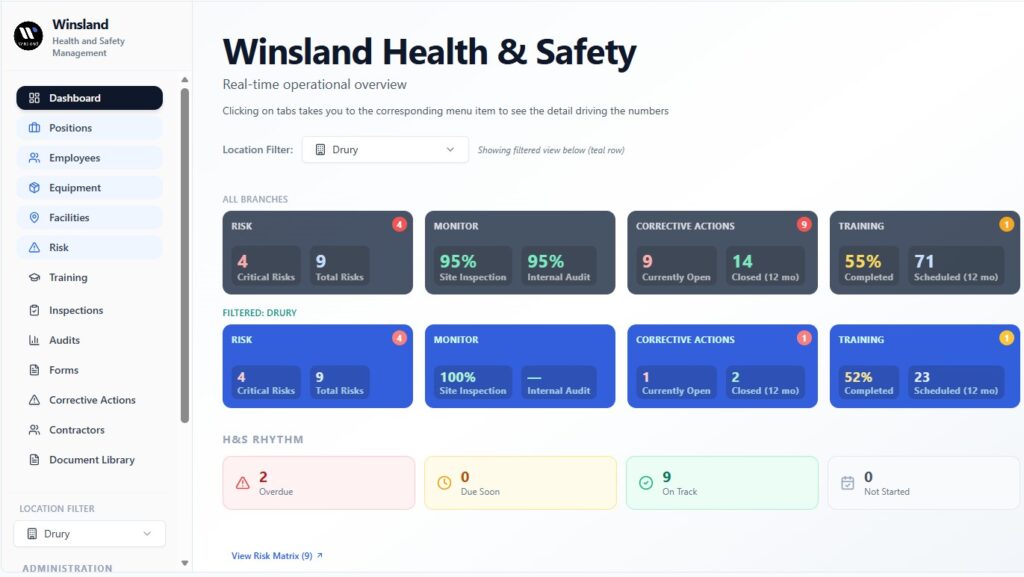
The Dashboard on the Winsland Health and Safety App gives a real time view of health and safety at any time – it is effectively a continuous audit process in itself.
External audit
Internal audits do not check things like risk register, training, corrective action close out. To check these and other aspects of the health and safety system, an external set of eyes is preferable. External audits are full scale formal audits normally conducted with outside specialists. Winsland provides these audit services.
Go walk-about
Informal (but regular) floor walks can be as good as the more formal processes. Maybe target specific aspects of the operation: Examples are;
- PPE
- Chemicals
- Fire and emergency systems / equipment
- Machine guarding
- Traffic Management
- Workforce engagement
- Workplace facilities
- Contractor management
How Winsland helps Auckland and NZ business with compliance
In the first instance, we provide a practical health and safety management system which SME can use to manage their health and safety. Therefore, if using our system, most SME are well on the way to ensuring safety and compliance.
As a leading health and safety consultancy operating in Auckland and nationally, we provide auditing to give you an independent view of the state of your health and safety and recommendations on what you can do to improve – see our audit services here.