
Is it Workers or managers that are incompetent
Why workers may be incompetent, in large part is that managers may not be as competent as they should be. With trades qualifications it is straight forward but beyond that it can be less obvious, particularly where there are no formal qualifications. But even if trades qualifications, there are tradesmen and there are tradesmen – holding the license does not guarantee performance. As a consequence, we see workers engaged for tasks they are not qualified by training and experience to perform, and without the backstop of direct and continuous supervision by a competent person. The result is workers putting themselves and others at risk and businesses exposing themselves to risk.
Options for determining competence
Training courses
What are the options for determining competence? Most would say training courses. This is reasonable for structured learning over a period of time which is reinforced on the job by a competent person. But for sure it is not about attending a one-day course !
By way of example: Workers can complete a 3 hour online course, for $98, in order to be awarded a “Excavator Operator’s Certificate” certificate. The features of this course may attract some as an option. Alternatively, a New Zealand Certificate in Civil Infrastructure Bulk Earthworks (Level 3) may be preferred. It can be obtained by completing a 29 week on campus course for $6,426.
Here is the analogy – at age 15 your child obtains their license. Do you now trust them to drive from Auckland to Wellington with snow and ice forecast for the Desert Road? Probably no. Its the same with workplace skills – attending a course (which people pay for so generally don’t fail) is only one small part of the picture – particularly if it is an online course completed by someone with English as a second language and the content is theory. It needs supporting and reinforcement back on the job.

One of the most common questions we get is when a refresh of a training course is required. The answer may be “never”. There are of no mandatory periods – for the simple reason that competence varies from person to person. Mandatory retraining periods, aside from first aid training, are typically no more that sales generators for training providers.
Experience
Formal training, if used, needs to be wrapped around experience – before and after. But certainly proven experience can be sufficient on its own. Operation of civil plant (earth moving equipment) there is no requirement for licensing unless the equipment is operated on public roads. Thus operators are often qualified by virtue of time spent on equipment on the job. Although courses are available to supplement this – see above for an example. Forklifts are another common piece of equipment for which there is no formal qualification.
Verification of competence (VOC)
To cater for the lack of formal qualification and to recognise the unique industry features, some organisations will run formal Verification of Competency processes. It may be but does not need to be a schedule of observable performance standards that need to be demonstrated, assessed by a competent person. Critically, it needs to be documented and it should not be a one-off.
Training Records / Competency register
Training and qualifications need to be documented. This enables the business to:
- allocate work based on skills
- prove worker competence to third parties – required for SSSP and pre-aualification.
- Track currency of qualifications and when training or VOC are due for renewal so people are always qualified.
The Winsland Health and Saftey App is the perfect tool for managing training. Training courses are set up in the App (Manage Courses) including links to training material such as standard worker or visitor inductions. Training is assigned to individuals either as individuals or by virtue of their position (Assign Training). The system emails the employee when training is due or overdue.
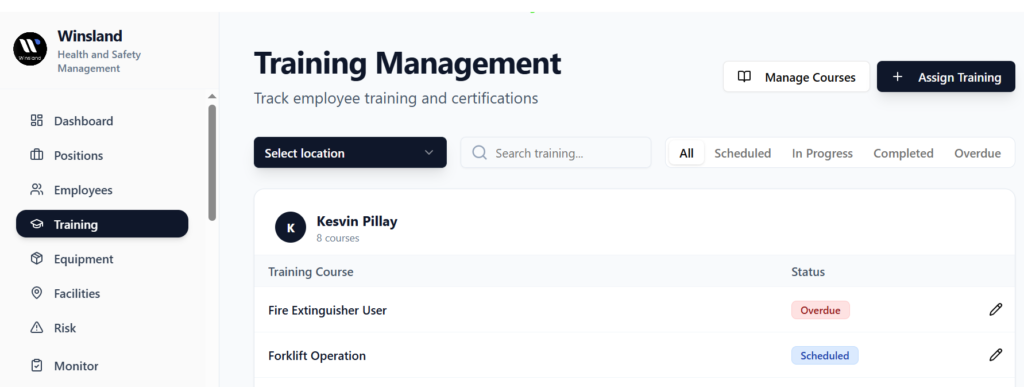
The App, among other things, reports the status of training for the whole organisation or, where there are branches, by branch.